GitOps Best Practices
What is GitOps?
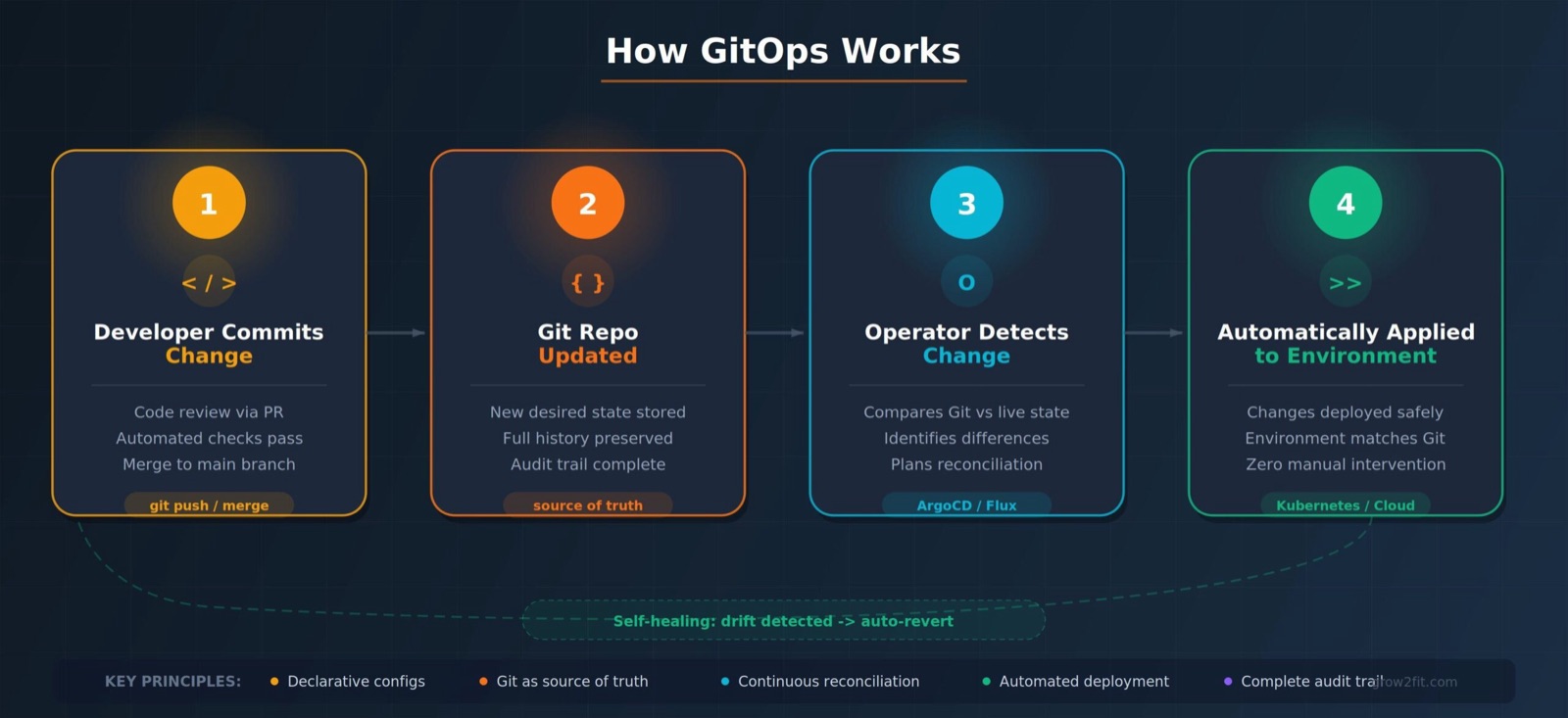
GitOps is an operational model where "Git is the single source of truth" for your infrastructure and applications. Instead of manually configuring servers or clicking through dashboards, you define everything in code, store it in Git, and let automation handle the rest.
The simple rule: What's in Git = What runs in production.
How It Works
- All configuration lives in Git — infrastructure, applications, policies
- Changes go through pull requests — code review, approval, audit trail
- A GitOps operator watches the repo — tools like ArgoCD or Flux
- Automatic sync — the operator ensures the live environment matches Git
- Self-healing — if someone makes manual changes, the system reverts them
Key Advantages
| Benefit | What it means for you |
|---|---|
| Faster deployments | Minutes instead of hours; no manual steps |
| Complete audit trail | Every change tracked: who, what, when, why |
| Easy rollbacks | Revert to any previous state with git revert |
| Reduced human error | No more "fat finger" mistakes in production |
| Enhanced security | No direct production access needed; all changes reviewed |
| Disaster recovery | Rebuild the entire environment from Git in minutes |
| Drift detection | System alerts when reality doesn't match desired state |
Common Use Cases
- Kubernetes deployments — manage apps, scaling, and updates across clusters
- Infrastructure as Code — provision cloud resources (VMs, networks, storage)
- Multi-environment management — consistent config across dev/staging/prod
- Compliance & governance — enforce policies, maintain audit trails
- Configuration management — centralize and version all system configs
Architecture Components
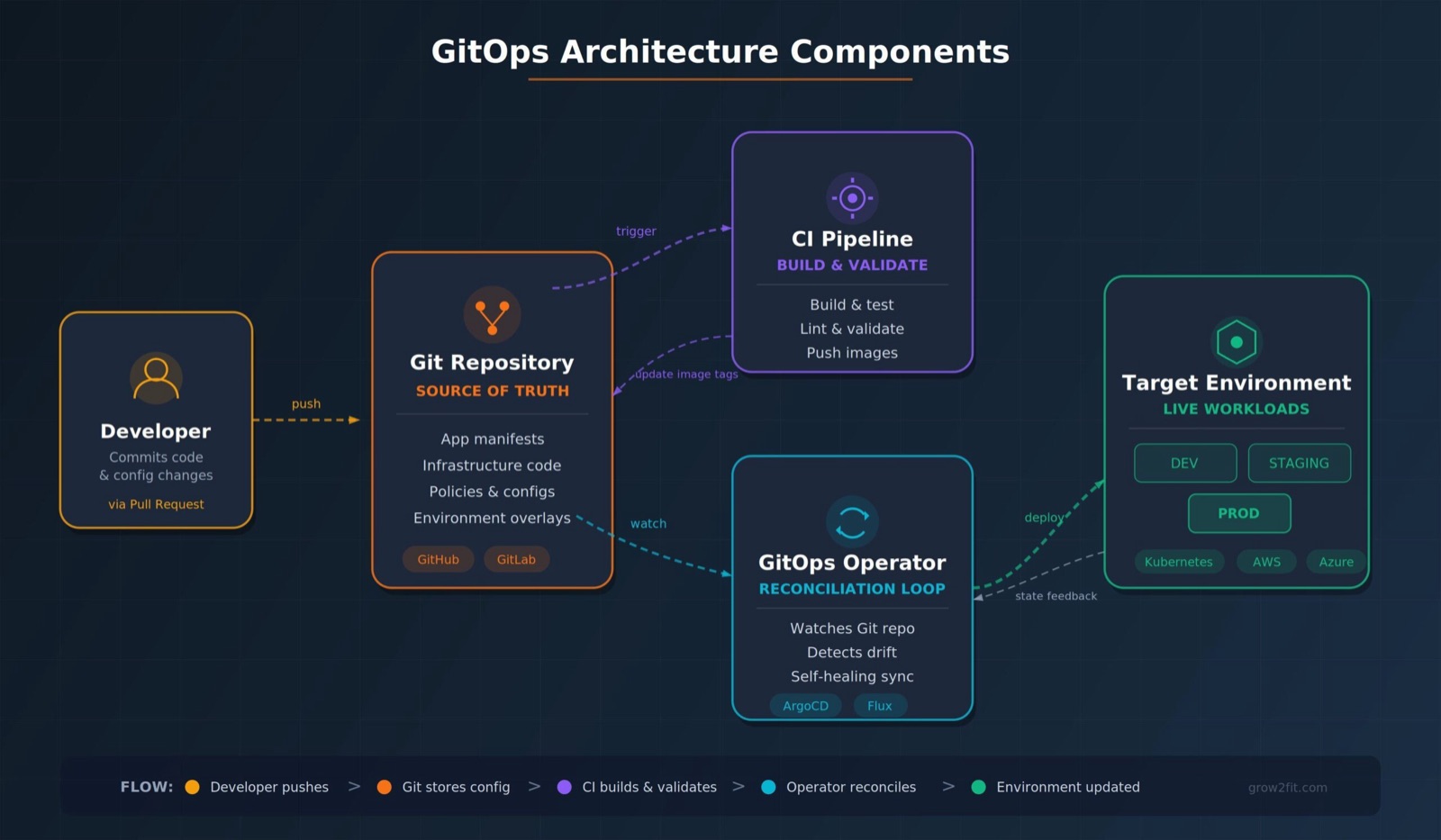
| Component | Role | Example tools |
|---|---|---|
| Git repository | Source of truth for all configs | GitHub, GitLab, Bitbucket |
| GitOps operator | Watches Git, applies changes | ArgoCD, Flux, Jenkins X |
| CI pipeline | Builds, tests, validates | GitHub Actions, GitLab CI |
| Target environment | Where workloads run | Kubernetes, AWS, Azure |
GitOps vs Traditional Deployment
| Aspect | Traditional | GitOps |
|---|---|---|
| Change process | SSH / console access | Git commit + PR |
| Audit trail | Scattered logs | Full Git history |
| Rollback | Manual, error-prone | git revert |
| Environment drift | Undetected | Auto-corrected |
| Access control | Prod credentials needed | Git permissions only |
Implementation Recommendations
Start with:
- One non-critical application or environment
- ArgoCD or Flux as the GitOps operator
- A clear repository structure (separate repos for apps vs infrastructure)
Repository structure example
├── apps/
│   ├── app-a/
│   └── app-b/
├── infrastructure/
│   ├── networking/
│   └── storage/
└── environments/
    ├── dev/
    ├── staging/
    └── production/
Most Common Mistakes in GitOps Implementation
- Not using linting / code checks: Failing to use linting or code checks often results in inconsistent quotation marks, indentation, and overall messy code. This makes maintenance difficult and increases the risk of errors.
- Poor secrets management: Whether it's committing secrets directly to the repository or not using an external secrets store, poor secrets management complicates audits and creates security risks. It also makes password rotation and automation harder.
- The "all-in-one" approach: We often encounter clients who keep all their Ansible playbooks or Terraform manifests in a single file. This makes the code difficult to read, maintain, and scale.
- Insufficient security for repository pushes: Allowing direct pushes to the main branch, merging pull requests without approvals, or not enforcing checks can lead to unauthorized or untested changes being deployed.
- Poor code segregation for different environments: Improperly designed segregation can lead to unintended changes in environments where they weren't intended, increasing the risk of misconfigurations.
- Manual interventions and ignoring GitOps: Making quick, temporary fixes directly on servers without updating the repository undermines the approach. These changes are not tracked, leading to configuration drift and inconsistency.

The Bottom Line
GitOps brings the same rigor we apply to application code to infrastructure management. The result: faster, safer, and more reliable deployments with complete visibility and control.
Key takeaway: GitOps reduces deployment risk and operational overhead while improving speed and compliance — benefiting both engineering teams and business stakeholders.
Where We Apply This
GitOps is central to how we build and operate infrastructure for regulated environments — banking platforms, payment systems, and fintechs operating under DORA and NIS2. Every principle in this article reflects what we deliver in production, not theory. Explore our infrastructure services to learn more.