Ilma · Module 1: Inventory
One inventory. Everything else reads from it.
An operational source of truth is one inventory of what you run and who owns it: the servers, the systems on them and the applications on top. Alerting, patching and reporting all read from it, so the answer to “whose server is this, and when may we patch it?” sits in one place instead of in someone’s head.
What the inventory records
Applications, the platforms they run on and the infrastructure underneath. Every record carries the same four attributes.
Applications and services
What the business uses. An application runs on a cluster or an instance, never directly on a VM.
- Owner
- Environment
- Criticality
- Patch group
Operating systems and platforms
OS, system software, clusters and instances.
- Owner
- Environment
- Criticality
- Patch group
Infrastructure
Sites, devices, virtual machines and networks.
- Owner
- Environment
- Criticality
- Patch group
In every record, on every level
Who gets the alert and who approves a change.
Production, test or development.
How fast a failure needs an answer.
Which maintenance window applies.
Who uses it
The four attributes are written in one place. Everything that needs them reads them from there, so a change of owner or window is one change, not five.
The alert goes to the team the inventory names
When ownership changes, routing changes with it. Nobody has to find and edit the alert rules that used to carry a team name.
- Owner
- Criticality
- Environment
Windows are data, not a table in an admin’s head
Patch groups and their windows live in the inventory. The automation reads them to decide which servers go into which night.
- Patch group
- Environment
- Criticality
Every change shows up on the charts
Dashboards show state against the inventory, and each change to it appears as an annotation: who changed what, and when. The audit trail needs no extra tool.
- All four
Catching drift
The inventory holds the desired state, written as code in Git. Automation keeps comparing it with what is really running and puts every difference on one dashboard, where someone resolves it.
Written in Git
A change is a merge request: checked automatically, approved by a person, then applied. Nobody edits the inventory by hand.
Compared with reality
Monitoring reports what actually runs: OS version, resources, when a server was last seen. The inventory never claims what only the server can report.
Unregistered assets
Servers that are running but missing from the inventory. Each gets a proposed record for a person to approve.
Drift
Reality differs from the desired state, such as a different OS version than the one on record.
On the dashboard
Every finding is listed, with the latest changes to the inventory next to it, until someone resolves it.
Examples of rules the pipeline enforces before a change is merged
- Every application has an owner.
- Primary and standby of one database never share a patch group.
- An application never runs directly on a virtual machine.
- Derived tags are generated, never typed.
What it looks like
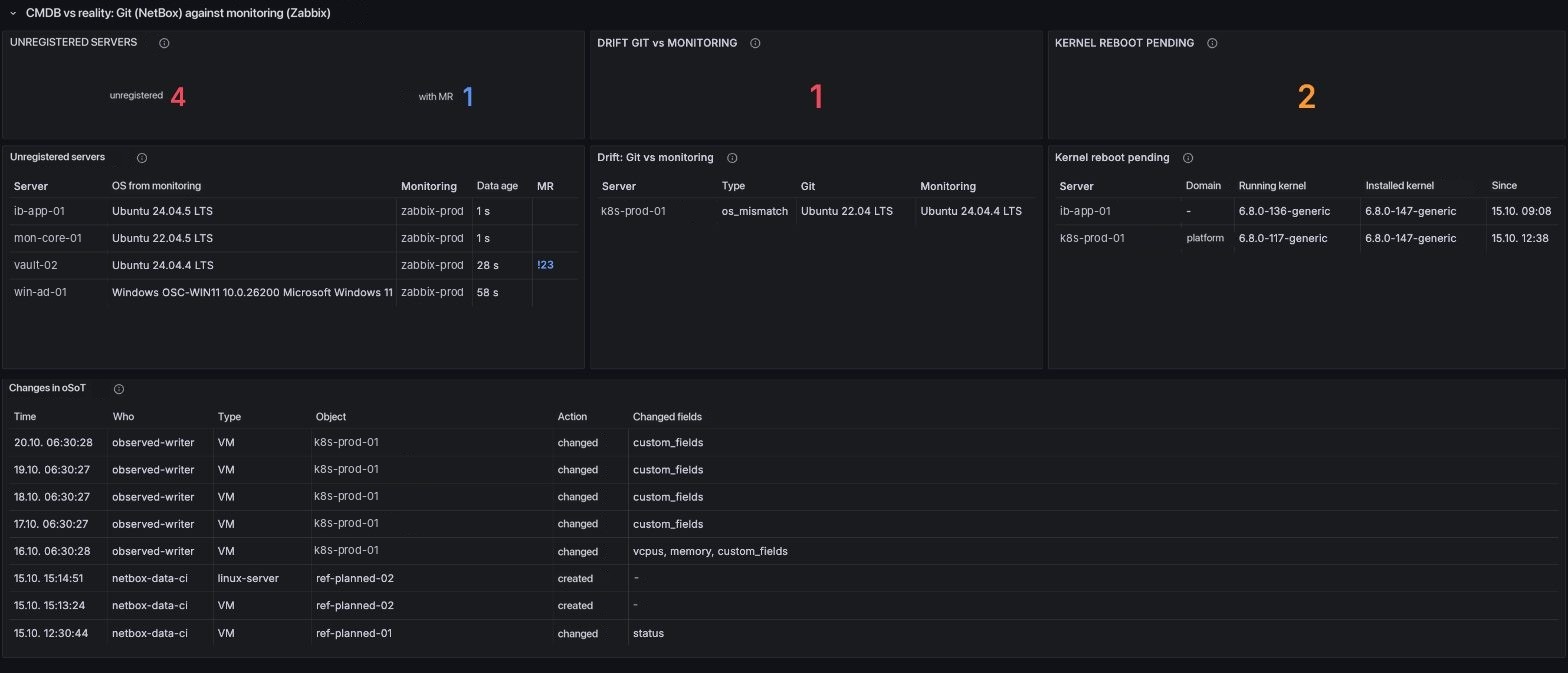
The dashboard where every finding lands. The coloured frames and numbers are added for this page only; the legend below says what each part shows.
 1
2
3
4
- 1Unregistered serversRunning and reported by monitoring, but missing from the inventory. One already has a proposed record waiting for approval.
- 2DriftA server running a different OS version than the one declared in Git.
- 3Reboot pendingServers with a new kernel installed that still run the old one. Read from monitoring, never stored in the inventory.
- 4Changes to the inventoryWho changed what, and when: automation writing measured values, and merged changes from the pipeline.
Tech stack
The inventory is the foundation module of Ilma, our operations framework: every other module works on top of it. It runs on proven open-source tools, joined by components we built to make them work as one.
Running a different monitoring tool or Git platform? We adapt the integrations to the stack you already have. For the rest of the platform this inventory feeds, see our reference stack.
See the inventory and its two checks running.
A live demo walks through the inventory, one change from merge request to dashboard, and both checks against reality. About an hour. No slides.